Showing posts with label australian. Show all posts

January 24, 2011

Australia Can No Longer Stay A Lone Nuclear Denier

Published on Monday January 24 2011

Last May, at a United Nations conference in New York, the veteran Japanese diplomat and director-general of the International Atomic Energy Agency, Yukiya Amano, glowingly endorsed civilian nuclear power.

He said, "More than 60 countries are now considering the introduction of nuclear power to generate electricity. It is expected that between 10 and 25 new countries will bring their first nuclear plants online by 2030."

Nuclear power "must be accessible not only for developed countries but also for developing countries", he said.

Japan has 54 nuclear power stations, two more under construction and 12 planned. The nuclear share of its electricity generating capacity will increase from about 30per cent today to more than 41 per cent by 2017.

This in an Asian nation that has experienced the horrors of Hiroshima and Nagasaki and which is regularly tested by nature's destructive forces. When I visited Kyoto in 1997, my Japanese colleagues reminded me that the nation's 54 nuclear power stations averted emission of 287million tonnes of greenhouse gases a year. Relying on Australian uranium fuel, this "carbon offset" was then more than all of Australia's emissions.

I recently addressed the World Renewable Energy Summit in Kuala Lumpur. High on the agenda was nuclear power for Asia.

An official paper from Korea entitled A Green Nuclear Utopia reminded delegates that in Korea 20 nuclear reactors produced about 17,700MW of electricity, meeting about 40per cent of the country's needs. Six more were under construction and six more planned.

This would ensure that the nuclear share of electricity generation would be in excess of 60 per cent by 2030.

Korea is now capable of marketing its own nuclear plant design to the world. Its order book for the construction of four advanced pressurised water reactors for the United Arab Emirates represents a contract worth more than $US20billion ($A20.2 billion).

Operation of these plants over the next 60 years is also worth about $A20.2billion. By 2050, the Korea Electric Power Corporation expects to have contracts worth more than $A506 billion.

China now contributes almost a quarter of the world's CO2 emissions.

Its volume of emissions over the past 10 years is greater than that of Brazil, Germany, France, Canada, Spain, Britain, Australia and Italy combined. 

China's energy policy is based on a 74per cent dependence on coal in 2010. By 2030, it is planned to reduce this to 50per cent, mainly by use of nuclear power. This will mean increasing the present nuclear installed capacity of 9000MW electric to about 190,000MW(e). Australia, in a similar bondage to the hydrocarbon industry, must learn from China's vision. It should start by introducing at least 5000MW(e) of nuclear power by 2020 and adopt a fixed carbon tax of between $10 and $20 over the next decade. Only in this way can we meet our United Nations emission reduction obligations.

In India 20 nuclear power plants supply more than 5per cent of its electricity. Four more reactors are being built, and the energy policy seeks at least 20 more by 2030.

A 2008 nuclear cooperation agreement with the US raises the possibility of foreign involvement in projects to generate as much as 63,000MW(e) of nuclear power by 2030.

Vietnam has firm plans for 15,000MW(e) of nuclear power by 2030. Indonesia is budgeting $A8.09 billion for four plants totalling 6,000MW(e) by 2025. The Philippines plans to rehabilitate an established but mothballed plant of 620MW(e) at a cost of about $A1.09billion.

Thailand plans to build at least 4000MW(e) of nuclear power commencing in 2014. Malaysia, which now produces almost two- thirds of its electricity from natural gas, has budgeted $A7.08 billion to build a large nuclear power plant by 2023.

As Asia "goes nuclear"  the new years's challenge for the Australian Government's Climate Change Committee is to tackle the problem of global warming with sound technology and informed realism.

This means re-examining and rejecting the pseudo-scientific and political attraction of "clean coal" and the semantically seductive utopian appeal of the costly "renewables".

Above all it means that the Australian Government must soon accept and endorse a now globally proven principle that at the heart of any successful emissions abatement project is the deployment of safe, secure and cost-effective nuclear power.

In Australia's case, an 80per cent historical base-load energy reliance on fossil fuels and chemical combustion must be replaced by the superb nano-technology of nuclear fission.

Recent polling clearly indicates that support for nuclear power in the Australian community is growing dramatically. Support for the technology is also beginning to emerge from both sides of Federal Parliament and from the offices of state premiers. Australia, the home of the world's nuclear fuels, can no longer sustain an appalling clean energy policy which makes it the sole "nuclear denier" among the planet's top 25 economies.

Professor Leslie Kemeny, a consulting nuclear scientist and engineer, is the Australian foundation member of the International Nuclear Energy Academy.


May 13, 2010

URANIUM GIANT CAMECO STRIKES EXPLORATION DEAL WITH RED METALS LIMITED -RDM


Announcement 13 May 2010
Red Metal (ASX: RDM) has struck a farm-in and an agreement with Cameco, one of the world's largest uranium miners.

The deal, with Cameco Australia, is over Red Metal's Lakes uranium project in the highly prospective Frome Sub-Basin of South Australia.

Cameco will gain an exclusive right over a six-year period to explore for uranium and earn a 51% interest in any or all of the four Red Metal Lakes Project tenements.

Cameco is required to sole fund AUD$4 million of expenditure and should it elect to earn a 51% interest in all four tenements, it would be required to contribute AUD$16 million.

The joint venture ensures a work program with a minimum total project annual commitment of $700,000 on exploration in the first year and $500,000 in subsequent years.

Once Cameco has earned 51%, Red Metal can elect to contribute to further exploration and development at a 49% interest or reduce to a 30% interest free-carried to a decision to mine.

Exploration on the Lakes project targets giant sandstone-hosted, roll-front type uranium plays hosted in the same Tertiary sedimentary sequences that host the nearby Beverley and Four Mile uranium deposits.

An extensive regional drill program completed last field season identified previously unrecognised thick, oxidised sand sequences in the prospective Eyre and Namba Formations at several locations as well as some anomalous uranium in reduced channel sands.

The anomalous uranium and oxidised sequences are considered significant as they indicate oxidising and potential uranium-bearing fluids may have passed through the rocks and deposited uranium mineralisation further down flow.

Cameco brings significant uranium exploration and development experience to the project.

Red Metal’s strategy of targeting giant ore deposits in many of Australia’s fertile terrains continues to attract major mining companies like Cameco as partners on attractive joint venture terms.

May 10, 2010

KEPCO IN TALKS TO BUY AUSTRALIAN URANIUM ASSETTS THIS YEAR - 2010


Korea Electric Power Corp., South Korea’s biggest electricity provider, is in talks to buy Australian uranium assets this year to meet demand for the nuclear fuel, an executive said.

“We’re talking with some Australian companies, so I think we can get a result this year,” Chung Jae Wan, general manager of the energy resources team at the utility known as Kepco, said in an interview today. Kepco is open to buying a stake in a project or a company, he said.


South Korean uranium demand is expected to double to 8,000 metric tons a year by 2020 because of increased construction of nuclear power plants, Chung told a conference earlier in Perth. South Korea, which imports about 97 percent of its energy requirements, plans to add eight atomic plants by 2016.


Kepco wants to buy mines that are in the construction stage, and isn’t interested in companies that only have exploration projects, Chung said. The Seoul-based utility is now progressing toward its goal.


“Given the uranium price, operating costs need to be reasonable,” he said. “If they’re too high, it cannot be developed into a mine. We need to be very cautious. We need some projects with reasonable operating costs which can be developed into mines under the current uranium price.”


Spot-market uranium prices fell 6.7 percent between the start of this year and early May on reduced purchases from China and concerns about U.S. Department of Energy plans to cut uranium inventories.


Resources Tax


In remarks to the conference, Chung said Kepco is “taking steps” to increase its holdings in uranium resources. “We will need one or two investments in uranium mines every year,” he said. Kepco is keen to buy stakes in uranium mines in Africa, Mongolia, Australia and Europe, the company said in March.


South Korea currently operates 20 nuclear power plants and had imported its uranium mainly from Canada, Australia and Kazakhstan until Kepco invested in overseas mines last year.


Australia’s proposed tax on resource company earnings won’t have a bearing on the South Korean company’s potential investment because Kepco is focused on uranium security more than the profitability of any purchased asset, Chung said.


“Kepco is a very big company,” Chung said. “We don’t have any limits in our investments. It depends on how attractive the investment is to Kepco.”

My Other Uranium News Site
LINK

March 19, 2010

RUSSIA TO BUY AUSTRALIAN URANIUM

The Federal Government has paved the way for Australia to sell Uranium to Russia.


An agreement was signed in 2007 by the Howard government but it is yet to be ratified.

In 2008 a Labor-dominated parliamentary inquiry recommended the deal be scrapped unless eight stringent conditions were met, including the resumption of inspections of Russian nuclear facilities by the global watchdog, the International Atomic Energy Agency (IAEA), and that Russia separate its civilian and military nuclear programs.

The Government has now decided the treaty contains "appropriate safeguards" for Australian uranium to be used in Russia's civil nuclear sector and says it will make a final decision on ratifying the agreement in due course.

That has angered the Australian Conservation Foundation's David Noonan, a nuclear free campaigner. He says under no circumstances should Australia seal the deal.

"This is the Howard-Putin nuclear deal from 2007, before the last federal election," he said.

"We had expected federal Labor to honour their policy and election commitments to strengthen, rather than to weaken, nuclear safeguards.

"They're looking to breach the strong conditions and recommendations of this federal parliamentary inquiry not to proceed with proposed uranium sales to Russia."

The Government says the agreement would ensure any uranium supplied could only be used for peaceful purposes and that it has to be subject to Russia's safeguards agreement with the IAEA. In addition, it could only be used in facilities jointly agreed to by Australia and Russia.

But Mr Noonan is doubtful.

"We believe that on the evidence presented to the federal parliamentary inquiry, Australian uranium would simply disappear off the safeguards radar on arrival in Russia," he said.

"This treaty allows Australian uranium to be used for facilities that are not covered by the International Atomic Energy Agency.

"It provides specifically for the substitution of Australian uranium for uranium from other countries and that they would then ignore essentially where our own uranium would go."

There is currently no obligation on Russia to accept safeguards under the IAEA rules.

Instead they have voluntary safeguard agreements with the IAEA and they ratified the Comprehensive Nuclear Test Ban Treaty a decade ago.

But Mr Noonan says the parliamentary inquiry recommended there should be a complete separation of the military from the civilian nuclear sector in Russia and that there should be independent verification of that separation.

He says that has not happened.

"The inquiry also recommended that there should be evidence that Russia was finally providing proper nuclear security on both visile material and on radioactive waste," he said.

"There is a long history of failure to provide security material in Russia."

______________________________

UPDATE ON OUTCOME


Coalition says selling Uranium to Russia, but not India, Hypocritical

Friday, 19/03/2010


The decision to sell uranium to Russia has been welcomed by the Federal Opposition, which started the process in 2007 when it was in power.

However, Federal Liberal Member for Kalgoorlie, Barry Hasse, says it's further evidence that India should be considered as a suitable market for our yellowcake.

Mr Hasse says the safeguards promised by Russia are exactly the same as those India plans to put in place.

"We're very happy that a trade relationship for minerals is developing with Russia and we felt the same about India, but when the Labor government came in, they wouldn't contemplate selling uranium to India," he says.

"There is very little difference (between the two countries) in fact, although India is not a signatory to the nuclear non-proliferation treaty .

"But there's very little difference in the cheques and balances in place in a practical way."

However, Mr Hasse says supplying Russia with uranium is positive not only for Australia's growing uranium industry, but for the reduction of global greenhouse gas emissions.


January 29, 2010

More Production, Resources For Australia's Paladin And Alliance Resources

Paladin Energy has enjoyed record quarterly uranium production and sales despite slower than expected progress at its Malawi mine. Meanwhile, Alliance Resources has confirmed a 16% resource increase at its Four Mile uranium project in South Australia.

Kayelekera (Image: Paladin)


Paladin's quarterly report for the final quarter of 2009 boasted record quarterly production of 987,310 lb U3O8 (380 tU) from its two operating mines in Africa. Most of this - 841,995 lb U3O8 (324 tU) - came from the Langer Heinrich mine in Namibia, which reached the anticipated production rates for stage 2 of the company's long-term four-stage expansion plan during the quarter.

The Kayelekera mine in Malawi, which started production in April 2009, produced a total of 145,315 lb U3O8 (56 tU) for the quarter. Ramp-up at the mine has been slower than anticipated because of problems encountered in the processing plant: specifically, the slow movement of uranium-loaded resin to elution, which has restricted the plant feed capacity. A secondary wash screening facility is to be installed in March or April, but in the meantime, improvements to the existing screening facility mean production should be much improved from the end of January.

The Australian company also reported record quarterly sales of 1.095 million lb U3O8 (421 tU) at an average price of $56.54/lb U3O8 and says it has signed a "substantial long term contract" with a major Asian utility covering the supply of over 4 million lb U3O8 (1539 tU), commencing in 2012. The company is also planning a trial shipment of uranium to China to "test and demonstrate the efficiency of logistics from Africa to Chinese conversion facilities."

More resources at Four Mile

Alliance Resources has announced a 16% increase to its mineral resource estimate for the Four Mile uranium project in South Australia. The resource now stands at some 71 million lb U3O8 (27,136 tU) at an average ore grade of 0.33%. The increase comes from an updated estimate for resources at the Four Mile West deposit, which now stands at 42 million lb U3O8 (16,112 tU) at an average 0.33% grade. The resource estimates include indicated and inferred resources at the Four Mile West deposit and inferred resources at Four Mile East, as classified under the JORC code (one of two standards used internationally in classifying uranium resources: it stands for Joint Ore Reserves Committee Australasian Code for Reporting of Exploration Results, Mineral Resources and Ore Reserves).

Four Mile is being developed as an in situ recovery (ISR) project through a joint venture of Alliance Resources (25%) and Quasar Resources (75%), with plans for a satellite ion exchange plant to carry out initial uranium recovery at Four Mile. The uranium-loaded ion exchange resin would then be trucked to Australia's only existing operational ISR uranium project, the nearby Beverley plant, for further processing.

All the resource estimates for Four Mile up to now have been made in anticipation of ISR as the only mining method, but Alliance reports that additional mineralization identified above or within about 20 metres of the water table in the western area of the Four Mile West deposit could potentially add up to 30% to the resource if proved recoverable by ISR or mineable by other means. According to Alliance, there is significant potential for further expansion of the resource base with other areas of mineralization awaiting further evaluation and drilling. Commenting on the latest announcement, Alliance Resources managing director Patrick Mutz described Four Mile as a "substantive uranium deposit which is still open in several directions."

January 19, 2010

RBS Equities Australia Say Cameco May Bid For Australia's Paladin Energy


Jan. 19 (Bloomberg) -- Cameco Corp., the world’s second-largest uranium producer, may be more interested in acquiring Paladin Energy Ltd. after the Australian company fell 15 percent in three months, RBS Equities Australia said.

“I think Cameco would certainly be looking at Paladin,” RBS analyst Lyndon Fagan said today. “Paladin’s share price has been underperforming recently because of failing to deliver on production targets, and the recent weakness could provide an opportunity for the likes of Cameco.”

The Australian uranium producer on Oct. 29 cut its production forecast after delays to an upgrade at the Langer Heinrich mine in Namibia and the replacement of equipment at the Kayelekera venture in Malawi. Perth-based Paladin estimated production of 5.6 million pounds to 6.1 million pounds for the year ending June 30, down from a previous projection of 6.6 million pounds.

Cameco declined to comment on a potential bid for Paladin. “As one of the world’s leading uranium producers, we are often associated with speculation about various business deals,” Lyle Krahn, a Cameco spokesman, said in e-mailed comments today.

Paladin Managing Director John Borshoff didn’t immediately return a phone call seeking comment.

The Australian uranium producer’s shares have fallen 15 percent from A$4.80 on Oct. 19 to close at A$4.07 yesterday, compared with a gain of 2.5 percent for the benchmark S&P/ASX 200 Index. Paladin traded at A$4.05 in Sydney, down 0.5 percent, at 1:35 p.m. local time, valuing the company at about A$2.9 billion ($2.7 billion).

Saskatoon, Saskatchewan-based Cameco, should it be interested in acquiring Paladin, would probably need to pay a premium of more than 30 percent to the Australian company’s share price, Fagan said by telephone in Sydney.

Speculation Not New

Discussion of a potential Cameco-Paladin transaction isn’t new. JPMorgan Chase & Co. said in March 2009 that Paladin may be an attractive target for producers such as Cameco. Speculation that Cameco may buy Paladin is increasing, and a takeover would cost the Canadian company about A$4 billion, the Australian Financial Review said in its Street Talk column today.

Paladin completed a share sale to institutional investors, raising A$429 million, the company said in September. Borshoff said last year the company may grow beyond Africa and Australia, while expanding its project in Namibia. Paladin will consider acquisitions of its own, he said in October.

Cameco, which plans to double annual uranium output from its existing operations by 2018, will consider acquisitions of mining assets and creating joint ventures with customers, Chief Executive Officer Jerry Grandey said in November. Paladin Energy is among the companies Cameco considers attractive, he said.

Even so, Grandey said: “We’ve always been challenged by the valuation.” Paladin shares rose 69 percent in 2009 to finish the year at A$4.18.

Cameco agreed to sell its stake in Centerra Gold Inc. for about C$872 million ($850 million), the company said last month.

The Canadian producer currently has “substantial financial capacity for acquisitions,” RBC Capital Markets analyst Fraser Phillips in Toronto wrote in a report yesterday.

By James Paton Jan. 19 (Bloomberg)


December 3, 2009

Australia's Clean Future In Nuclear Power


WE may not be getting an emissions trading scheme any time soon but the climate and energy crises still need fixing with real urgency.


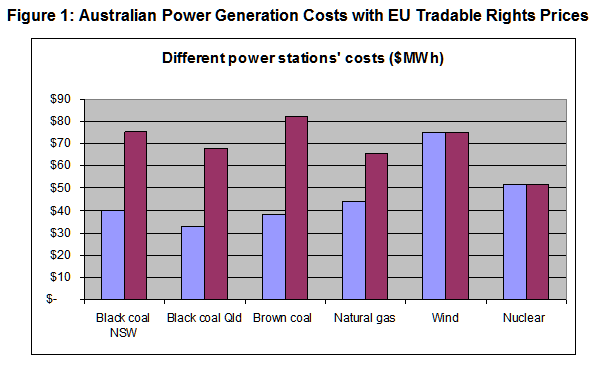
Applying the EU price of $41 per tonne of CO2, cost to current power sources would result in nuclear power becoming marginally cheaper than coal and natural gas generation.


For climate, the issue is excess greenhouse gases from burning fossil fuels. For energy, the crisis is dwindling supplies of those fuels and air pollution from coal combustion.

Replacement energy sources need to be reliable, plentiful and economic to deploy. They need to be low-carbon to minimise global warming. Business-as-usual or half measures risks saddling future generations with a climatically hostile planet and energy scarcity.

Nuclear power is one obvious replacement source, but typically raises five objections.

First, readily available uranium supplies are limited. If the world was wholly powered by present-style nuclear reactors there would be at most a few decades of energy before cheap uranium was exhausted.


Second, nuclear accidents have happened in the past, suggesting this technology is dangerous.

Third, expansion of nuclear power would risk the proliferation of nuclear weapons.

Fourth, we would leave future generations with the legacy of long-lived nuclear waste.

Fifth, large amounts of energy (and possibly greenhouse gases) would be required to mine, mill and enrich uranium and to build and later decommission nuclear power stations.

All the above points have merit, although their relative importance comparedwith climate change and critical energy shortages is debatable. But there is little point in debating these objections because none will apply to future nuclear energy generation.

Almost all today's nuclear power stations are thermal reactors. These use water to slow the neutrons that cause uranium atoms to split (fission) and to carry the heat generated in this reaction to a steam turbine to generate electricity.

Because of the gradual build-up of fission products (neutron poisons) through time, we end up getting less than 1 per cent of the useable energy out of the uranium. The rest is thrown out as that long-lived waste.

In contrast, newer fast reactors are able to use almost all of the energy in uranium. There is enough energy in already mined uranium and stored plutonium from existing stockpiles to supply all the world's power needs for more than three centuries before we need to mine any more uranium.

Fast reactors can be used to burn all existing reserves of plutonium and the nuclear waste from the past and present generation of thermal reactors. With additional uranium mining, there is enough energy in proven deposits to supply the entire world for many thousands of years. This deals with the first objection.

As to the second objection, modern reactors use passive safety systems requiring no operator intervention to shut down the reaction. This makes them safe. So safe that a certification assessment for Westinghouse's AP-1000 reactor put the risk of a core meltdown such as the one that occurred at in the US in 1979 at Three Mile Island at once every 24 million reactor years.

Comparing the flawed Chernobyl design to today's reactors is like saying modern aviation is too dangerous because the Hindenburg airship exploded in 1937.

On the third objection, proliferation, the nuclear fuel used by fast reactors is initially very radioactive, making it impossible to divert to a nuclear weapons program without an expensive, heavily shielded, off-site reprocessing facility that would be readily detected.

In fact, the only nuclear waste materials that will ever leave an Integral Fast Reactor complex (which has on-site recycling) are fission products, which decay to background levels of radiation within a few hundred years.

Unlike conventional nuclear waste, which can last for hundreds of thousands of years (the fourth objection), the waste from IFRs can be more readily stored because of its small volume (150 times less than used nuclear fuel from thermal reactors) and short storage times.

The fifth objection, concerning greenhouse gases generated in building nuclear power plants, has never stood up to detailed life-cycle analysis.

Renewable energy sources (such as wind and solar) use significantly more raw materials per unit of energy generated than even present-generation nuclear power stations and the full life-cycle emissions, including nuclear fuel production, are similar from both sources. When energy storage and fossil-fuel back-up are included, wind and solar emissions are much higher.

A possible sixth objection could be that we don't need nuclear power when we can use renewable energy. This is a valid objection for countries with abundant hydropower, conventional geothermal power or biomass, the only three renewable sources of proven reliable power that can deliver energy 24 hours a day at an acceptable cost. Solar and wind sources, however, still rely heavily on fossil fuels to deliver reliable, continuous energy.

At today's pace of commercial development we won't see many fast nuclear reactors delivering power to the grid before 2020. This will seem too late for some, but at the present pace, non-hydro renewables will only meet 2 per cent of global energy use.

Either option, therefore, requires radically accelerated research, development and deployment if it is to make a difference to climate change and energy supply. What's required is a project of Manhattan-style proportions or the audacity of the moon-shot vision.

Let's be clear. We have the means to fix the climate and energy crises, or at least avert the worst consequences. New generation nuclear power, supported by an expansion of the thermal reactor fleet, is one possible path to success and one that all nations should support. Rationally considering energy planning requires letting go of old-school thinking about exciting new technologies.


Martin Nicholson is the author of Energy in a Changing Climate. Barry Brook is professor of climate change at the University of Adelaide's Environment Institute.


November 18, 2009

Australian Opposition Anger At India-Canada Uranium Deal


Australia's federal opposition is complaining of what it calls a colossal missed opportunity for Australia, after it was revealed that Canada is soon to resume uranium sales to India.

The Canadian Prime Minister Stephen Harper has visited New Delhi to sign a series of agreements on trade and energy, and he has also announced a new civilian nuclear deal with India, which will include big new uranium sales.

India has been asking for Australian uranium for years, but the government of Prime Minister Kevin Rudd has a ban in place preventing any sales.

Windows Media Link
To Above Article


Recent News Regarding Canada's Close Ties With India
September 2009

OTTAWA -- Canada is close to signing a deal with India to sell nuclear technology and materials, Trade Minister Stockwell Day said on Friday, adding he was confident that remaining security concerns would be resolved.

Mr. Day made similar comments in May, saying at that time that a deal was imminent.

He told reporters on a conference call that he was now ironing out a few final stumbling blocks.

"I had a telephone meeting just last week with India's national security adviser. We are down to four fine points ... He and I both agree that final agreement is possible within days, if not just a matter of a few weeks," Mr. Day told reporters on a conference call from India.

Mr. Day said he did not foresee any threat of Canadian materials being diverted to military uses elsewhere in the region because of India's commitment to allow inspections by the International Atomic Energy Agency as well as tough transparency and reporting requirements.

"These are very strong provisions," he said.

Canada halted nuclear co-operation with India after the country diverted material from Canadian-designed reactors to make a nuclear bomb in 1974. The conflict between India and Pakistan at the time led to widespread international concerns about India's nuclear intentions.

Canada and other countries lifted their moratorium on nuclear trade with India last year.

Mr. Day said one of the four items to be resolved before signing a deal was the "question of reprocessing", without providing details.

"I'll let our negotiators make progress on those and the others without unduly trying to raise pressure points publicly on them," he said.

The deal means Canadian uranium producers will be able to sell to an Indian market that is seen, along with China's, as one of the top areas of growing demand for nuclear fuel.

Cameco, a top uranium miner, recently said it plans to open a marketing office in India.

"Certainly we're looking forward to having the opportunity to do business in India. It's a large market opportunity for any uranium fuel supplier," said Cameco spokesman Lyle Krahn.

The company plans to open the office next month.

"Once we have the agreement in place, we'll certainly be moving forward," Cameco's spokesman.

On Wednesday, the Canadian government announced a similar nuclear deal with Kazakhstan, where Cameco already has operations.

November 4, 2009

Nuclear Restart For Refurbished Canadian Units Gets The Green Light

3rd November 2009

Two reactors at Canada's Bruce A nuclear power plant that have been out of service for over a decade have been given regulatory approval for refueling and restart. At the same time, the Canadian Nuclear Safety Commission (CNSC) has announced five-year operating Licence renewals for the Bruce A and B nuclear power stations.


Units 1 and 2 at the Bruce A plant have been undergoing a major refurbishment to replace their fuel channels and steam generators plus upgrade ancillary systems to current standards in an operation that should enable them to operate for a further 25 years. The announcement by regulator CNSC that refueling can go ahead means the project looks to be on line for the projected 2010 restarts.

The regulator also announced that it had decided to renew the operating licences for Bruce A and the four-unit Bruce B plant, with the new licences valid from 1 November 2009 to 31 October 2014. (The five-year renewal is in line with Canadian regulatory practice, whereby nuclear power plant operating licences are granted for a fixed term and must be renewed periodically.)


As part of its ruling, CNSC has requested that detailed information on the status of the refurbishment of the Bruce A units and on the status of Bruce Power's follow-up monitoring be included in its own annual Status Report on Power Reactors. It has similarly requested detailed information on the status of Bruce Power's follow-up monitoring, ageing management, any safety-significant dates for equipment, and any forecasted end of life plans, be included in the annual Status Report for Bruce B.

Units 1 and 2 at the four-unit Bruce A plant started up in 1977, but unit 2 was shut down in 1995 because a steam generator suffered corrosion after a lead shielding blanket used during maintenance was mistakenly left inside. In the late 1990s then-owner Ontario Hydro decided to lay up all four units at the plant to concentrate resources on other reactors in its fleet, and unit 1 was taken out of service in December 1997 with units 3 and 4 in following in 1998. The four units at sister power station Bruce B continued to operate. Bruce Power took over the operations of both Bruce plants from Ontario Hydro in 2001 and restarted units 3 and 4 by early 2004. Bruce A units 3 and 4 are likely to undergo a similar refurbishment once units 1 and 2 are back in operation.


The decision to refurbish the units followed a 2005 agreement by Bruce Power and the government of Ontario to refurbish the two 769 MWe Candu reactors as a faster option than building new ones in the face of impending power shortages. A similar approach has been adopted elsewhere in Canada, with refurbishment work already completed at Pickering A units 1 and 4, ongoing at Point Lepreau 1 and planned to commence at Gentilly 2 in 2011.

Bruce Power decided to withdraw its application for a third nuclear power station at Bruce in July, saying it would focus on the refurbishment of the existing Bruce plants rather than building Bruce C. It also announced it was scrapping plans for a second new nuclear plant at Nanticoke in Ontario.


Visit My Other Site Australian Uranium Investing


.

October 30, 2009

Queensland Government Called On To Lift Uranium Ban


AUSTRALIA'S uranium sector has renewed its attack on the Queensland government for continually rejecting mining yellowcake in the sunshine state.

Alan Eggers, the man who had built Queensland's most successful uranium explorer, Summit Resources, said the ban was irrational and illogical.

"It is a political ban that has no basis of science, health or safety or commercial or any other area," he said at yesterday's Brisbane mining conference.

"It is time Queensland and the public of Queensland woke up and got into this business, which is a very safe business to be in, which will create a lot of jobs and a lot of royalties and wealth and knowledge and technology for the state."

Toro Energy managing director Greg Hall told the conference the government's list of reasons for continuing its ban on uranium mining did not stand up.

The Queensland Labor government has continually said it has no plans to lift its ban on uranium mining.

"There have been multiple reasons why the Queensland government has decided that uranium mining is not suitable for this state," Mr Hall said.

"It started some time ago, with the government saying that it didn't want competition for coal and there was an expensive report done that proved that uranium was not competition for coal."

Mr Hall added that another concern was competition for funds during the global financial crisis, which he said had not been an issue as many uranium companies had recently raised capital.

"The people of Queensland have to rethink why is the government against uranium mining?" he said.

"Is it a throwback to old 1970s rhetoric or is it something that is genuinely there?"

In contrast, Western Australia is now full steam ahead with uranium activity after Premier Colin Barnett's Liberal Party lifted the ban on mining yellowcake last year.

South Australia, with BHP's massive Olympic Dam mine, and the Northern Territory, with ERA's Ranger mine, are both pro-uranium. Victoria and NSW have blanket bans on both exploring and mining

uranium.

Geological Survey of Western Australia executive director Tim Griffin said the industry was excited when Mr Barnett lifted the uranium ban.

"There is a lot of new work going on in Western Australia on the exploration side, but more particularly in trying to get a mine up and running in the next fours years and the industry is confident it can do that," he said.

"The government is definitely supporting that target and (is) focused on trying to make the changes to allow that to happen."


August 15, 2009

Australia To Supply Uranium To India

Australia to supply uranium to India
Thursday, 13 Aug 2009

India has expressed its interest in having civil nuclear cooperation with Australia, amid indications that the two countries are likely to sign an energy agreement in November under which Australia may supply uranium for joint venture power plants.

Australia’s policy of not supplying uranium to countries that have not signed the Nuclear Non proliferation Treaty was noted by External Affairs Minister S M Krishna, who had discussions on a wide variety of bilateral subjects with Australian Prime Minister Kevin Rudd and his counterpart Stephen Smith.


Mr Krishna told a press conference that While we have noted Australia’s position on the issue of the supply of uranium to India, we would be interested in having civil nuclear cooperation with Australia as well, as and when it is ready.

Mr Krishna said that India needs to expand the use of nuclear power to meet our growing energy requirement in a climate friendly way. We are thankful for Australia’s support in IAEA and NSG. Following the NSG waiver we have been making progress on civil nuclear cooperation with partners such as US, France and Russia.

Mr Rudd is expected to visit India in November when the two countries are likely to sign an Energy Declaration for generation of nuclear power for which his country may supply uranium.


Chinese Nuclear plans forge ahead
16 June 2009
Loading...

Two new heavy forging milestones have been reached with Russia's new "super-powered" forge as large as any in the world and the first large pressure vessel completely made in China.

Developments such as these are coming increasingly rapidly as the global supply chain prepares to meet a surge in orders for new nuclear power systems.

A ceremony yesterday marked the shipping of the reactor pressure vessel for the Ling Ao Phase II unit 2. The reactor is a domestically engineered 1080 MWe unit and the production of a pressure vessel of this size in China is a first. The component, measuring over 13 metres long and weighing over 320 tonnes, was made at Dongfang (Guangzhou) Heavy Machinery's Nansha facility in Guangdong province. Unit 1 and unit 2 at Ling Ao Phase II are to enter commercial operation towards the ends of 2010 and 2011.


Ling Ao Phase II unit 3 reactor pressure vessel (CGNPC)


The Chinese-produced reactor pressure vessel (Image: Dongfang)


China Guangdong Nuclear Power Company (CGNPC), which owns Ling Ao, said the achievement of Dongfang in making the component was a 'major breakthrough to accelerate the progress of self-reliance of nuclear power... to improve the level of the industrial chain.'


Each time CGNPC has built a new reactor it has been able to increase the amount of domestically made components. The first two at Ling Ao, based on an imported French design built nearby at Daya Bay, featured around 30% Chinese components. The figure rose to 60% at Ling Ao Phase II, to 75% at Hongyanhe, to 80% at Ningde and to 83% at Yangjiang.


"Super-powered" complex

Meanwhile, Russia's efforts to increase its own nuclear supply chain bore fruit with the completion of a "super-powered next generation steel melting complex" at OMZ's Izhorskiye Zavody facility. The development is a major step towards the forging of single components from ingots of up to 600 tonnes in weight - equivalent to the largest facilities anywhere in the world.

Japan Steel Works is seen as the leader in this area of super-heavy forgings, but has now been joined by OMZ while two Chinese and one British firm could soon join the super-heavyweight club. Shanghai Electric Company and Dongfang are planning forges that will accept 600 tonne ingots, while Sheffield Forgemasters is hoping for government help to build one to accept 500 tonne ingots.

The improvements at OMZ are part of a Russian strategic plan to gear up for work in the nuclear, oil, gas and general energy sectors. The improvements were financed by GazPromBank. OMZ said the new capabilities "will put an end to foreign producers' monopoly in the production of rotors for low speed turbines and generators." Large half-speed turbines are planned for new Russian nuclear power units under a 2007 deal with AtomEnergoMash and France's Alstom, which have a joint venture to build the non-nuclear half of the power plants.

Farid Kantserov, chair of OMZ, said: "This is a momentous event for the entire Russian machine building industry as it confirms our willingness to take an active part in the development of the domestic nuclear energy sector and to compete successfully with leading Western companies in the foreign market."