October 3, 2013

China Set To Build 200 Nuclear Power Plants

Published on Thursday October 03 2013 (AEST)  
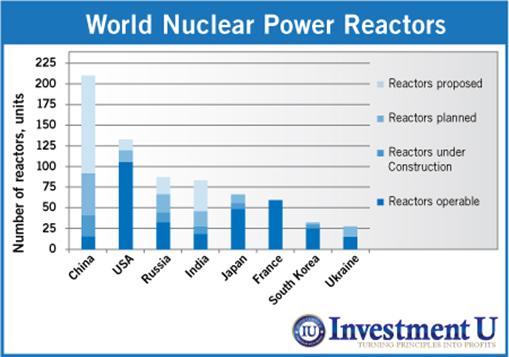
Beijing: China plans to build 200 new nuclear power plants and speed up the construction of 29 more as part of efforts to cut the high level of emissions generated by the large-scale use of coal. 


China’s demand for nuclear plants will reach 200, with four to six new projects being approved annually before 2015, said Jian Jingwen, deputy head of the equipment department at the State Nuclear Power Technology Corporation.

The number will touch 10 plants every year after 2020, Jian was quoted as saying by state-run China Daily.

China plans to increase nuclear power generation capacity from 10.7 gigawatts in 2010 to 160 gigawatts in 2040, the report said.


China is also strengthening its efforts to develop clean energy. When it comes to finding a solution to China’s air pollution problem, experts and environmental officials are unanimous in their belief that nuclear power is the way to go even though misgivings remain, the report said.

China will also account for 40% of the global net increase in nuclear capacity between 2010 and 2040, the report said, quoting an international energy outlook released by the US Energy Information Administration.

A total of 29 atomic plants are being built after the Chinese government lifted a ban imposed after the Fukushima nuclear plant disaster in Japan.

Nuclear energy is preferred as China is unable to bring down the high pollution levels generated by excessive use of coal in most manufacturing units, officials say.


.


.

October 1, 2013

ASX Uranium Explorer Aura Energy Adds To Uranium footprint In Mauritania

Published on Tuesday October 01 2013 (AEST)  

Aura Energy (ASX: AEE) has an opportunity to add to its 49 million pound uranium resource in northern Mauritania, with a deal which would add 1,000 square kilometres of prospective ground in the Reguibat calcrete uranium province.

The region is regarded by many as one of the world's least explored for calcrete uranium deposits. The deal with Groupe Azizi could expand the company’s existing nearby Oum Ferkik resource of 16 million tonnes at 305pp U3O8.

Reconnaissance by Aura, and work by Groupe Azizi, has previously confirmed the presence of widespread uranium mineralisation at, or close to surface, in the two permits.

 Several pits dug by the company contained visible carnotite mineralisation that returned between 400ppm and 540ppm eU3O8, measured by spectrometer.

In addition, the permits contain 30 square kilometres of strong radiometric anomalies that Aura’s recent experience in the Reguibat Project indicates is directly linked to uranium mineralisation.

Under the terms of the Agreement, Aura can earn a 65% interest in the tenements by completing a preliminary feasibility study.

The company is currently assaying 150 samples of soils collected from the permits by Groupe Azizi to obtain a better picture of the distribution of uranium.

It then plans to carry out ground radiometric surveys and further sampling to define targets for drilling.


.


.

September 19, 2013

ENERGY RESOURCES Moves To End Uranium Mines Toxic Water Spills

Published on Thursday Sept 19 2013 (AEST)  

 Energy Resources has installed new equipment to overcome toxic water problems at the Ranger Uranium mine near Kakadu National Park in the Northern Territory.  

U3O8- ERA Moves to end Uranium Mines Toxic Water Spills

Energy Resources of Australia ( ERA ) has spent $220 million on a brine concentrator to treat contaminated water Chief executive Rob Atkinson says it is a worthwhile investment. "The brine concentrator is a critical component of ERA's future," he said. 

The successful treatment of process water is key to rehabilitating the site. "Without this, I do not believe we would have a future." The miner says clean water from the concentrator can be released into wetlands, and the toxic brine left behind will be collected and buried in the disused open-cut mining pit. ERA says the concentrator will produce around five million litres a day of clean water a day, or 1.8 billion litres a year. 

The Australian Conservation Foundation ( ACF ) says the move is long overdue. ACF spokesman Dave Sweeney says while the new equipment is a good thing, damage to the environment has already been done. "That mine has been plagued with water management and contamination problems for decades," he said. He says the equipment should help to address chronic water problems. "It will be an important part of the next phase of operations at Ranger," he said. 

"The next phase is about closure, clean-up, and a measured and comprehensive rehabilitation and exit."


.


.

September 12, 2013

Queensland Takes Next Step To Uranium Mining

Published on Thursday Sept 12 2013 (AEST)    

U3O8- Queensland Takes Next Step To Uranium Mining Industry Thursday, 12 September 2013 10:40 Andrew Cripps 

Brisbane 12 September 2013. The Newman Government has today taken the next important step in re-establishing the uranium mining industry in Queensland. Natural Resources and Mines Minister Andrew Cripps today released an action plan to implement a best practice regulatory framework for uranium mining in Queensland that will ensure the maintenance of strict environmental, safety and approval standards. The government has developed this implementation strategy in response to a detailed report by the Uranium Mining Implementation Committee ( UMIC ) which was released in March 2013, Mr Cripps said. 

The strategy outlines the actions various state government agencies will deliver and covers all aspects of the approvals process, including environmental standards, safety and health, economic and community development, indigenous opportunities and native title. Mr Cripps said uranium exports had the potential to generate significant revenue for Queensland over the next two decades. With an estimated value of the in-ground uranium resource in Queensland of approximately $10 billion, with more than $8 billion located in north-west Queensland, the industry has real potential to support economic growth and job creation,” he said. 

The government's focus is to ensure all the uranium-specific regulatory guidelines and protocols are in place to begin assessing applications from mid-July 2014. Importantly, the Newman Government has endorsed the Committee’s key finding that, with certain adaptations, Queensland’s existing systems for regulating mining and radiation safety are robust and can accommodate uranium across the mining cycle. The best practice regulatory framework will take account of all relevant issues across the uranium mining life cycle such as:


  - Whole of project assessments (including tenure management)

 - Safe handling and transportation

 - Safety and health risk management systems

 - Environmental management, and

 - Native title  


A Uranium Mining Oversight Committee will be established to review and monitor progress against the action plan and take a lead role on technical oversight issues, project governance and delivery timeframes. Mr Cripps said commercial demand for uranium would determine when uranium mining would recommence in Queensland. There are a number of factors that will influence the timing of uranium mining operations and it is ultimately a commercial decision for industry proponents," he said. 


These factors include the world market price for uranium, supply and demand in that market, and mining costs. The Queensland Government's role is to provide investment certainty for industry by having best practice regulatory, compliance and approval processes in place. Cheers to Campbell Newman :)

 This is great news for the Queensland Uranium Industry :)

 .


.


.